Tony Danza speaks at Northeast High’s graduation ceremony
I'd Like to Apologize to Every Teacher I Ever HadTony Danza speaks at Northeast High’s graduation ceremony as the commencement speaker for Northeast High’s Class 169, delivering the public culmination of his year at Northeast High School. Although he did not officially teach the graduating seniors, he had come to know many through the half-sandwich club, talent shows, dances, and coaching. His speech therefore occupies an unusual position: it is formally addressed by an outsider to a class he did not instruct, but emotionally delivered by a teacher who has shared the school’s daily life and been changed by it.
Setting and Occasion
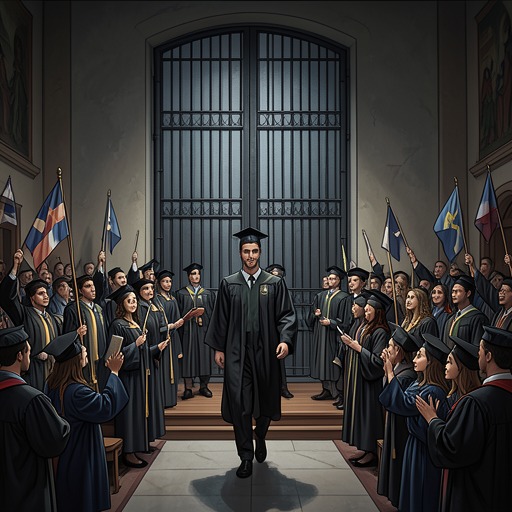
The ceremony takes place at noon on an otherwise ordinary school day, with the attention of the campus concentrated on commencement. Northeast High School’s football field is prepared beneath a bright blue sky, the stands are filled with parents, relatives, and friends, and chairs await nearly seven hundred graduates. Tony Danza shares the dais with Ms. Carroll, district officials, the senior faculty adviser, and the senior class president. The scale of the gathering turns his personal school-year experiment into a public institutional moment.
The ceremony opens with “Pomp and Circumstance,” and Mr. Flaherty spends more than an hour announcing each graduate’s name. The women wear Viking red, while the men wear black with red ties. The procession presents the graduating class as both a large collective and a visibly diverse group of individuals, while the packed stands contrast with the sparse audience that had once disturbed Danza in a documentary about an inner-city school. Here, the students’ achievement is witnessed by a community that has gathered to affirm it.
Speech and Central Arguments
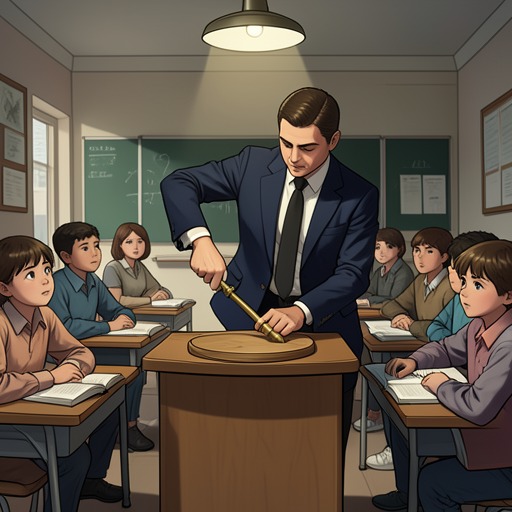
Danza begins by introducing himself as “Tony Danza, a.k.a. Mr. Danza,” turning his celebrity identity into the school identity he has earned during the year. He acknowledges the comic awkwardness of addressing students he did not officially teach, recalling the football-playing seniors who helped him decorate his classroom before the school year began. His jokes about “fadeless paper,” “graphic organizer,” “model it,” “collaborative learning,” and “Venn diagram” make the language of teaching part of the ceremony rather than keeping it at a distance.
The speech’s first serious claim is that graduation represents an achievement against formidable odds. Danza tells the students that nearly fifty percent of American high-school students do not finish, so receiving a diploma means that they have beaten the odds and “set the table for a good life.” He immediately links achievement to continued effort: the graduates have time and opportunity to discover their passions, but they must keep working to become good at whatever they choose. Graduation is not presented as a final reward; it is a beginning that creates responsibility.
Danza then makes time the speech’s governing image. He urges the graduates not to waste it because time is finite, and he supports the warning with Shakespeare’s account of the tide in human affairs, in which an opportunity taken at the flood leads toward fortune while a missed opportunity leaves life bound in shallows and misery. The quotation extends the ceremony beyond immediate celebration, asking the students to understand their lives as shaped by choices made under limited conditions.
His practical advice is deliberately unvarnished. He tells the graduates to take care of themselves, avoid abusing their bodies, and take their time with love. He warns the young women that the young men may be irresponsible and tells the young men to act responsibly, emphasizing that one wrong move can change a life. Because Danza has seen Northeast students and their older siblings “crash and burn” during the year, the advice is not abstract moralizing; it is his attempt to convert observed consequences into protection for the students leaving school.
Families, Teachers, and Shared Responsibility
The speech assigns part of the graduates’ future to their families. Danza thanks parents and relatives for supporting their children, but he insists that schools and teachers cannot sustain education alone. He asks families to create a culture that celebrates learning and to maintain high expectations. At the same time, he recognizes that the graduates are no longer simply children: parents must begin calling on them to become adults, even if that process is incomplete. The ceremony thus marks a change in the family relationship as well as the student’s institutional status.
He also offers an explicit tribute to Northeast’s teachers. He thanks those who were present every day, endured students’ moods, told them to put away phones and remove earbuds, agonized over grades, and worked to provide what students would need later in life. This acknowledgment broadens the meaning of graduation. The diploma belongs to the students, but the achievement is represented as the product of persistent relationships among students, families, and teachers rather than of individual effort alone.
Danza’s own position has shifted enough that he can speak from within that professional community. Earlier in the year, Lynn Dixon’s daily management of the Arts and Education Small Learning Community had shown him how teachers were burdened by mandates, deadlines, technology requirements, student advocacy, mediation, and even the repair of essential equipment. By graduation, his thanks to colleagues carries the weight of having experienced that labor firsthand. The speech is consequently both a commencement address and a public recognition of work that is usually invisible.
Personal Transformation and Closing Ritual
The most personal declaration comes when Danza tells the graduates, “This has been the greatest year of my life.” He says that he learned more and worked harder than ever before, met people he would always look up to, and encountered students he would never forget. His conclusion is not that he successfully remade the school, but that the students and colleagues made him “a different and better person.” The value of the ceremony therefore reverses the expected direction of instruction: the teacher publicly credits the students with educating him.
He closes in English-teacher mode with Rudyard Kipling’s “If,” reciting its sequence of tests involving crowds and kings, enemies and friends, virtue, endurance, and the disciplined use of every minute. The poem’s final image, “And—which is more—you’ll be a Man, my son!”, gives the speech an old-fashioned moral register, while Danza’s preceding emphasis on responsibility and self-care makes the passage a serious appeal to maturity. He follows it with the imperative “Make your lives count!” and then breaks the solemnity by asking, “Any Vikings in the house?” The stadium answers with a roar fueled by delight and, perhaps, relief that the long speech has ended.
After photographs and hugs, Danza returns to his classroom, where his remaining dedicated students present an album commemorating the year. The book is affectionate but irreverent: “Danza’s Top Ten Dumb, Annoying Habits” mocks his pronunciation of “idea,” his heavy sweating, his repeated use of “schmo,” and his refrain, “You can do it, you can do it.” The students’ teasing gives the commencement sequence its final emotional balance. Public ceremony, literary exhortation, and professional gratitude give way to the private language of a class that knows its teacher well enough to laugh at him. Danza responds by laughing and crying at once, leaving the school-year narrative suspended between performance and genuine attachment.